Tankless Water Heater Size Calculator (Free Tool + 2026 Sizing Guide)
Tankless Water Heater Size Calculator
Pick what could run at the same time, choose your region, and get your result instantly.
Buying a tankless water heater that’s too small is one of the most frustrating home upgrades to get wrong. The shower runs hot until someone opens the kitchen tap, and then it goes lukewarm. Buy one that’s too big, and you’ve paid hundreds of dollars more than you needed to, plus possibly a bigger gas line or an electrical panel upgrade.
The good news is that sizing a tankless heater comes down to two numbers, and the free calculator above works out both for you. Below it, you’ll find a plain-English guide that explains the math, the numbers to look for on a spec sheet, and the mistakes that trip up most homeowners.
Key Takeaways
- Size a tankless unit by flow rate (GPM) and temperature rise, not by tank gallons.
- Homes in northern states need far more heating power than homes in the South.
- Most families of four need roughly 6 to 8 GPM at their winter temperature rise.
- Always size for the coldest month of the year.
How the Calculator Works
A tankless water heater has two jobs at once. It has to deliver enough hot water per minute, which is the flow rate, and it has to heat that water fast enough, which is the temperature rise.
The calculator first adds up the flow rate of every fixture you selected. Then it subtracts your incoming ground water temperature from the temperature you want at the tap. That difference is your temperature rise.
For gas units, the heat required is about GPM × temperature rise × 500, divided by the unit’s efficiency. We assume 95%, which is typical for modern condensing models. For electric units, the rule of thumb is GPM × temperature rise × 0.1465, which gives you kilowatts.
Pro tip: Manufacturers publish a flow chart for each model that shows its GPM at different temperature rises. Once you know your numbers, compare them against that chart, not just the headline BTU rating.
Typical Flow Rates of Household Fixtures
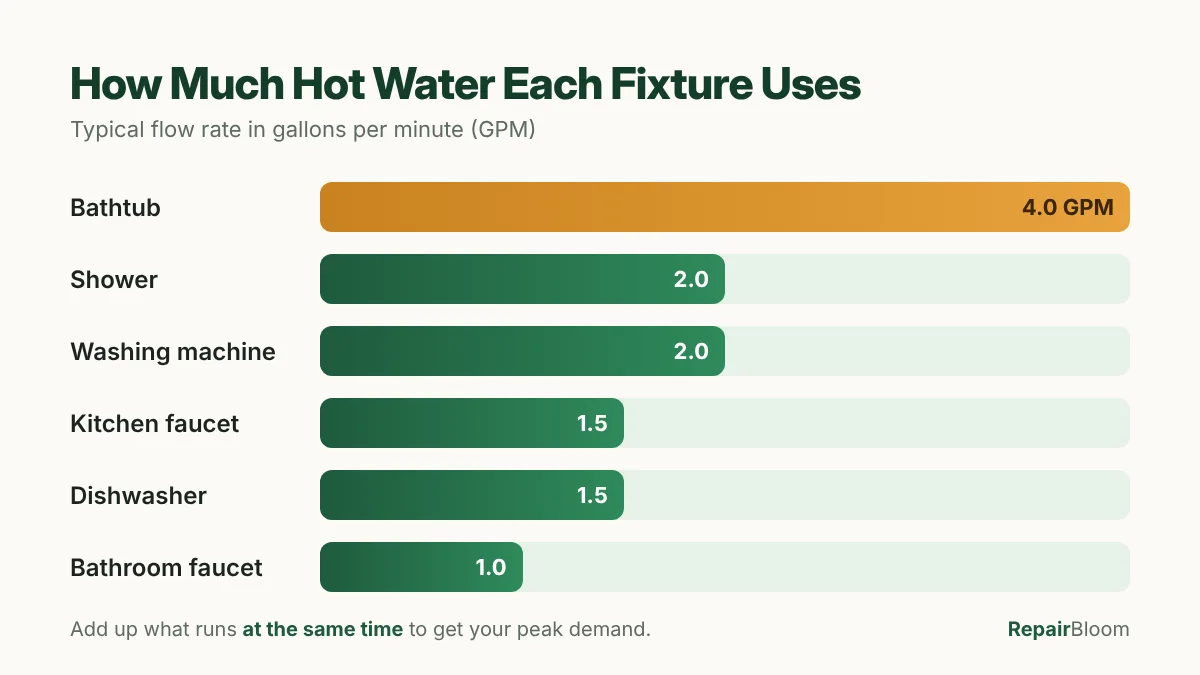
Every fixture in your home has a flow rate, usually printed on the shower head or in the product manual. Here are typical ranges for US homes:
| Fixture | Typical flow (GPM) | Used in calculator |
|---|---|---|
| Shower head | 1.8 – 2.5 | 2.0 |
| Bathroom faucet | 0.5 – 1.5 | 1.0 |
| Kitchen faucet | 1.5 – 2.2 | 1.5 |
| Dishwasher | 1.0 – 2.0 | 1.5 |
| Washing machine | 1.5 – 3.0 | 2.0 |
| Bathtub | 4.0 – 6.0 | 4.0 |
If you’ve installed low-flow WaterSense fixtures, your real numbers may be lower, which can let you choose a smaller and cheaper unit.
Why Your Location Changes Everything
Ground water in Minnesota can drop close to 40°F in winter, while in South Texas it often stays near 70°F. To reach 120°F at the tap, a home up north needs an 80°F rise, but a home in the Deep South needs only 50°F.
That’s a huge difference. The same tankless unit that easily runs two showers in Houston may struggle to run one and a half in Minneapolis.
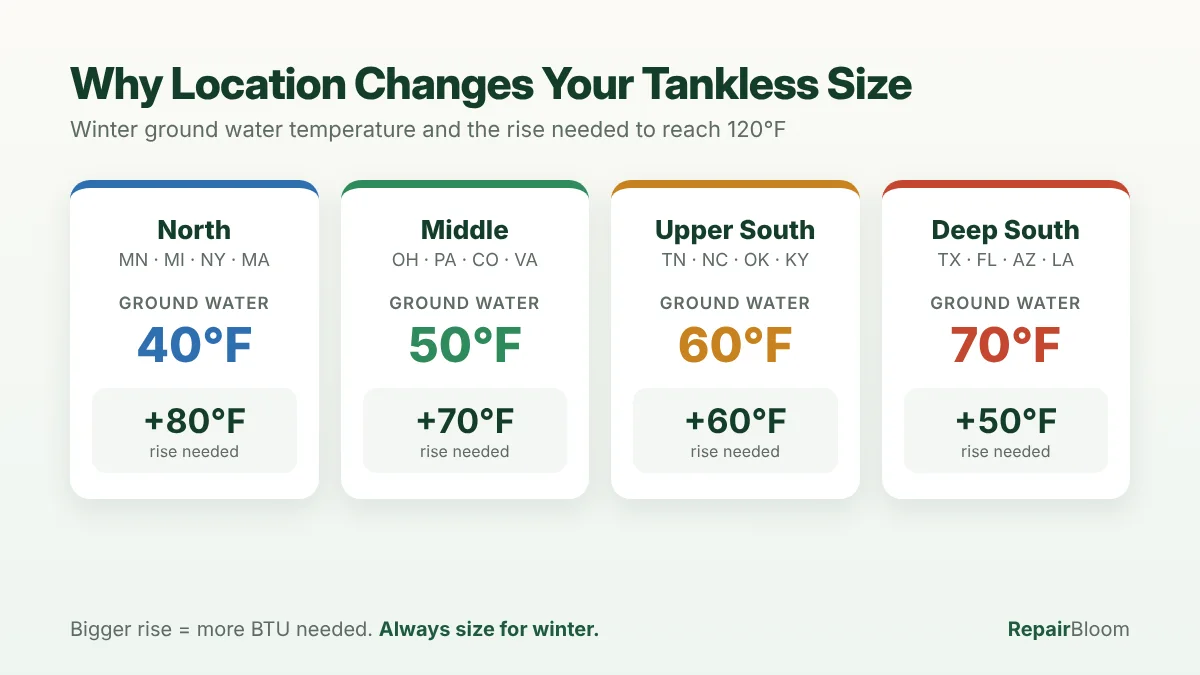
Size for winter. If you size your unit using summer water temperatures, you may get lukewarm showers in January, exactly when you want hot water most.
Recommended Size by Household
Use this table as a quick starting point, then confirm with the calculator above:
| Household | Typical peak demand | South (gas) | North (gas) |
|---|---|---|---|
| 1–2 people | 3–4 GPM | ~120,000 BTU | ~150,000 BTU |
| 3–4 people | 5–7 GPM | ~150,000 BTU | ~180,000–199,000 BTU |
| 5+ people | 7–9+ GPM | ~180,000–199,000 BTU | Two units, or a very high-output model |
Gas vs. Electric Tankless
Gas (natural gas or propane)
Gas units are the go-to choice for whole-house hot water, especially in colder states. Most whole-house models are rated between 150,000 and 199,000 BTU per hour. They need proper venting and often a larger gas line than an old tank heater used.
Electric
Electric units are simpler to install and need no venting. But a whole-house electric unit can draw 100 to 150 amps or more, and many older homes need an electrical panel upgrade before one can be installed. They work best in warmer climates or as point-of-use heaters for a single bathroom.
Common Sizing Mistakes to Avoid
- Counting every fixture in the house. Only count what realistically runs at the same time during your busiest hour.
- Using summer water temperature. Always size for the coldest month.
- Ignoring the gas line. A 199,000 BTU unit on an undersized gas line won’t reach its rated output.
- Forgetting the electric panel. Check your panel’s spare capacity before buying an electric unit.
- Trusting the box alone. “Whole-house” on the box means little. Check the manufacturer’s GPM chart at your temperature rise.
Frequently Asked Questions
What size tankless water heater do I need for a family of 4?
Can one tankless water heater run two showers at once?
Is a bigger tankless water heater always better?
How accurate is this calculator?
Disclaimer: This tool provides estimates for planning purposes only. Always follow the manufacturer’s instructions and your local building codes.